
News
OUR WORK IN ACTION

Boston's Climate Action Plan
We’ve explored NYC’s groundbreaking Climate Mobilization Act, and now it’s time to turn to Boston’s Climate Action Plan. Boston’s Mayor Walsh set a goal of making Boston carbon neutral by 2050, and buildings must reduce their carbon emissions by at least 15 percent every 5 years.

Boston’s iconic John Hancock Tower.
We’ve explored NYC’s groundbreaking Climate Mobilization Act, and now it’s time to turn to Boston’s Climate Action Plan.
Carbon neutral by 2050
Boston’s Mayor Walsh set a goal of making Boston carbon neutral by 2050. Buildings and transportation make up 99 percent of Boston’s carbon emissions, and the Climate Action Plan primarily focuses on these carbon sources.
For buildings, new construction is transitioning to zero-net carbon.
For existing buildings, which contribute more than 70 percent of Boston’s carbon emissions, the Building Energy Reporting and Disclosure Ordinance (BERDO) has two goals:
1. Make building owners, tenants, and other stakeholder more aware of their energy usage and greenhouse gas emissions through public annual reporting.
2. Reduce carbon emissions through audits and actions every five years.
Building Energy Reporting and Disclosure Ordinance (BERDO)
Like New York City, certain building types and sizes account for the greatest amount of carbon pollution, and are regulated under the City’s ordinance:
Non-residential buildings 35,000 square feet or larger.
Residential buildings 35,000 square feet or larger or with 35 or more units.
Any parcel with multiple buildings that sum to 100,000 square feet or 100 units.
As of 2019, these buildings must also conduct an energy assessment or take an energy action every five years.
The Climate Action Plan requires either an improvement in the regulated building’s Energy Star rating by at least 15 points or a reduction of at least 15 percent of the building’s annual:
Energy usage.
Energy use intensity.
Greenhouse gas emissions.
Greenhouse gas intensity.
The reduction’s benchmark is based on the annual reporting over the previous five years.
Building owners can achieve the required reduction through:
Energy efficiency improvements.
On-site renewable energy projects or off-site renewable energy purchases.

Looking up from the Freedom Trail.
Where do windows fit in?
High performance windows, even for landmarked buildings, can help meet the 15 percent reduction in energy usage or a 15-point increase in the Energy Star rating. Our New England Team, together with our manufacturing partners, can create bespoke high performance windows for virtually any application, including net-zero new construction projects.
Bespoke, hand-carved mahogany, and high performance
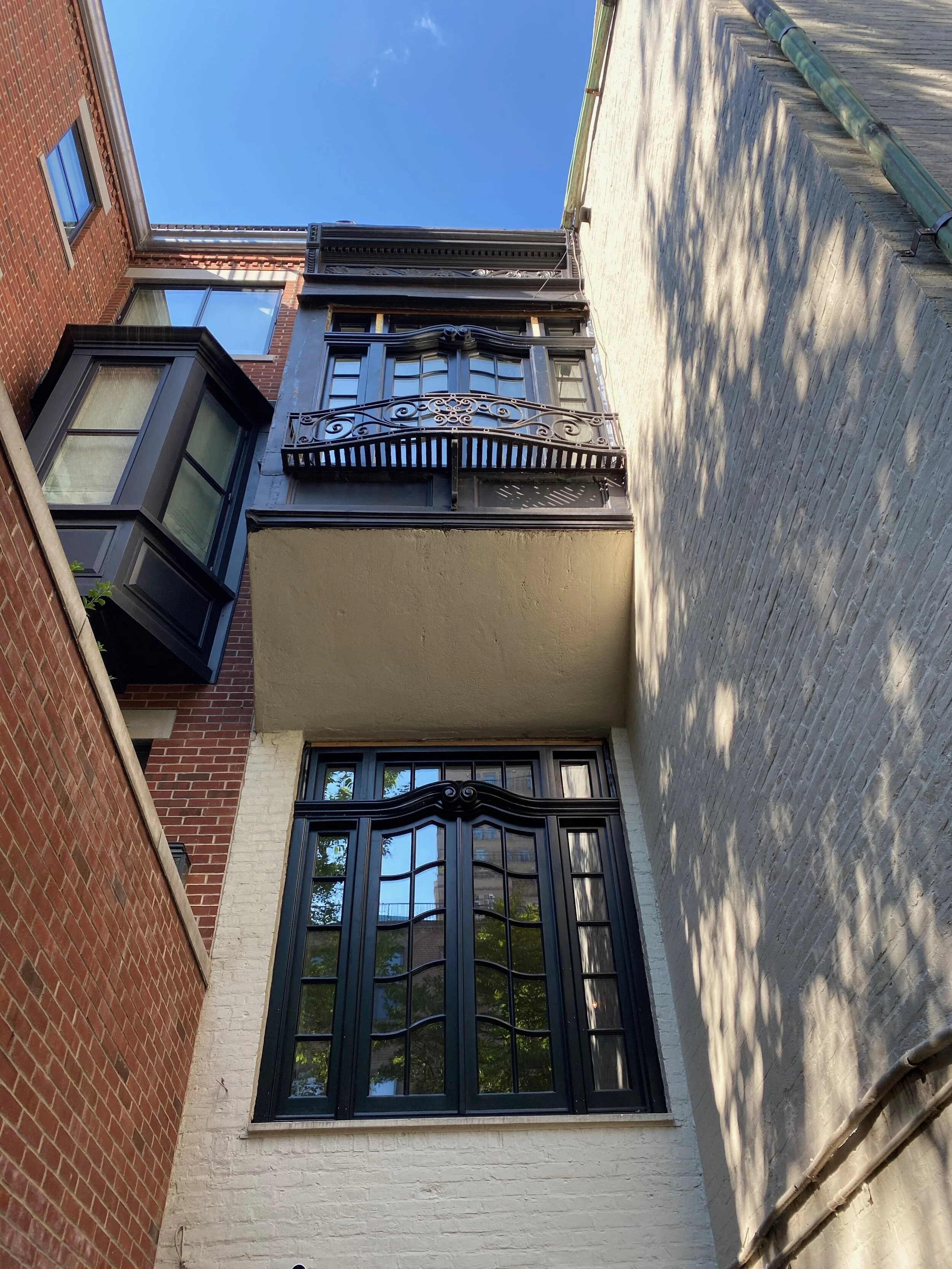
This iconic home is the perfect representation of respecting historical architectural features while integrating time-honored craftsmanship and modern materials and technology for energy performance and safety.
This Landmarked slip of a townhouse (only 18.25 feet wide!) on the Upper West Side got a gorgeous rear facade makeover with custom mahogany doors and windows.
We installed custom French inswing doors with sidelites from LePage in the kitchen. The glass is both tempered and high performance for safety and energy efficiency.
In the living room and master bedroom, we installed huge bespoke hand-carved mahogany double arched windows topped with transoms and sidelites from Mahogany Entryways. The glass is high performance argon-filled with a low-e coating. Outswing screens with concealed hinges to let fresh air into the 4,176 square feet home completes the window package.
This iconic home is the perfect representation of respecting historical architectural features while integrating time-honored craftsmanship and modern materials and technology for energy performance and safety.
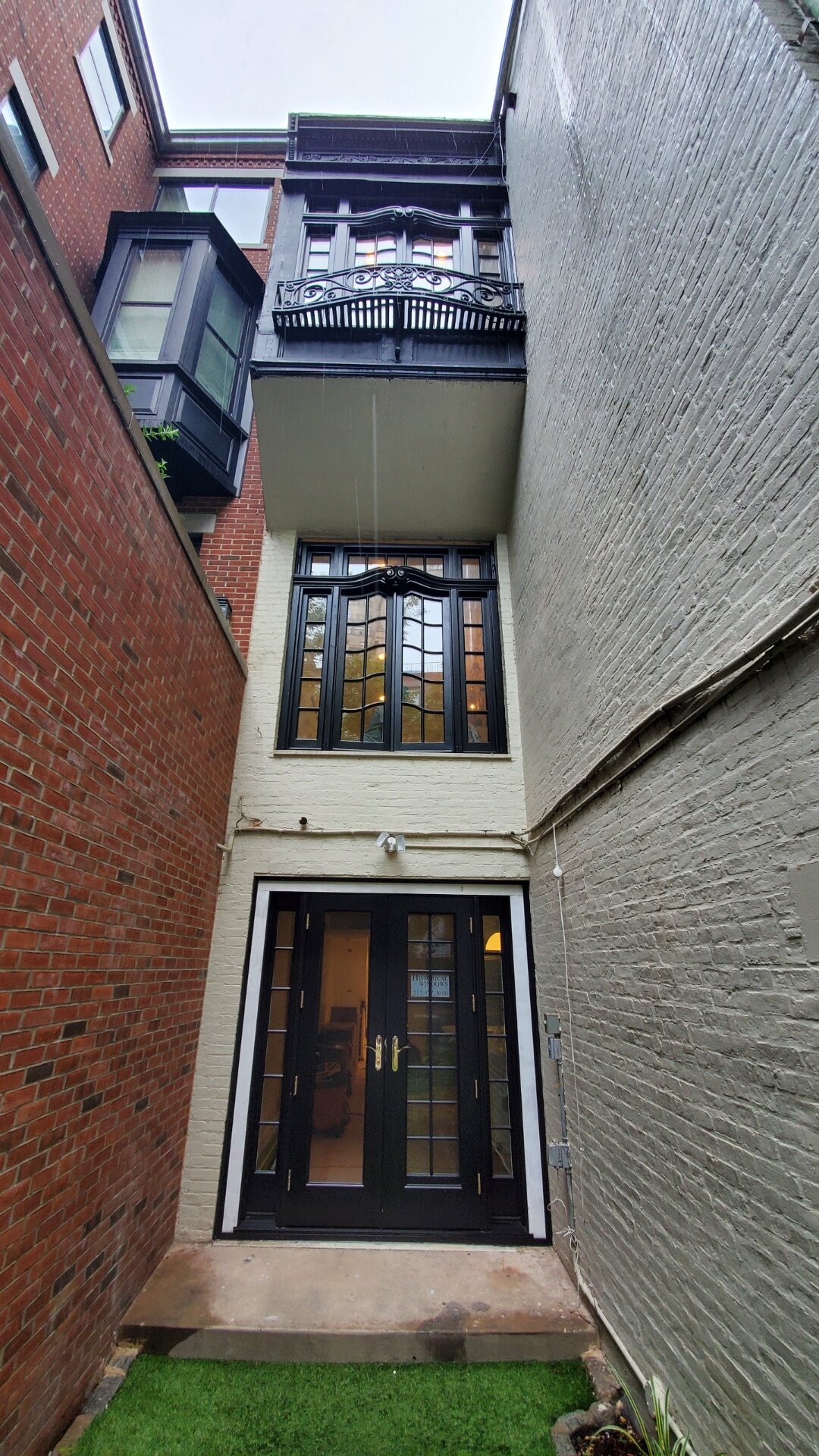

Assembling the hard-carved mahogany window, shipped from the artisans in Honduras.
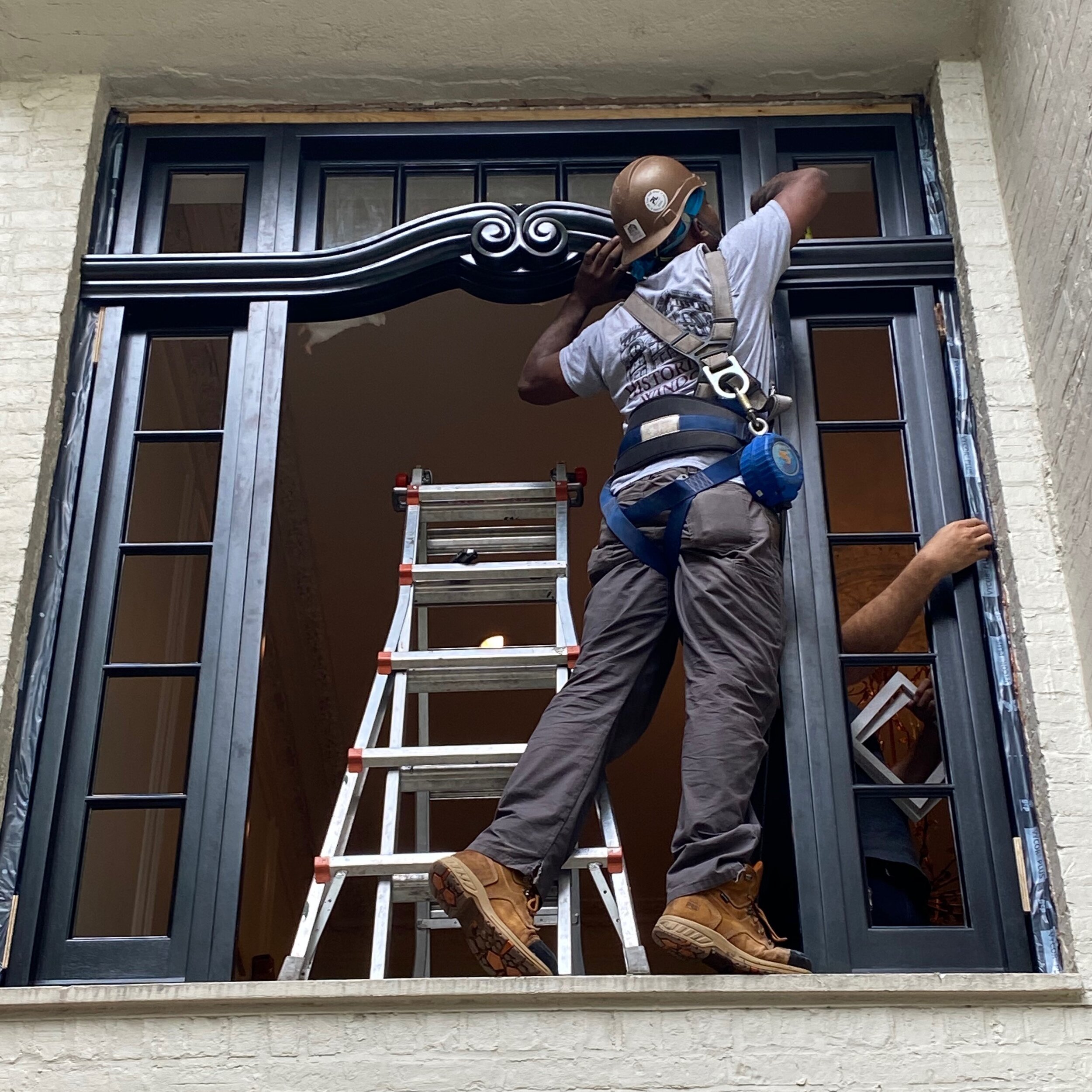
Installing the new double-arched window is equal parts art, science, and a balancing act.

Stained glass: art & function
The art of making stained glass windows is about 1,000 years old. Traditionally, stained glass was used in churches, synagogues, mosques, and other religious edifices. They were primarily used to tell a story to the lay people that were largely illiterate at the time.

Vividly colored stained glass windows in a religious edifice.
The art of making stained glass windows is about 1,000 years old. Traditionally, stained glass was used in churches, synagogues, mosques, and other religious edifices. They were primarily used to tell a story to the lay people that were largely illiterate at the time.
Today, only about ten percent of stained glass is manufactured for use in religious building. The vast majority of it is now destined for municipal and commercial buildings and private residences. Many times, stained glass transoms or door sidelites are used to accent residential buildings, but stained glass can be used in single-hung and double-hung windows as well.
Stained glass is made when metallic salts are added to the soda ash during the glass manufacturing process. A quick reminder: glass is made by heating sand, lime, and soda ash at a very high temperature. Then the molten glass is annealed, or slowly cooled down.
Red glass is made by adding selenium oxide or copper compounds. Gold chloride stabilizes the red color, which is why even today red stained glass is more expensive than other colors.
Yellows and ambers are made using sulfur, cadmium sulfide, carbon oxide, or uranium oxide.
Green glass is made with iron oxide, uranium oxide, chromic oxide, or copper compounds.
Blue and indigo glasses are achieved with cobalt oxide. Copper compounds can also be used to make blues.
Violet glass is made using manganese dioxide or nickel oxide.
White glass is formed with antimony oxides.

Stained glass can take a modern, geometric form in stationary transoms and sidelites as well as in operational windows and doors.
A stained glass artist first develops their design—whether it’s a pattern or picture. The design is transferred to a template the size of the window, then again into a black and white format called a cartoon. The cartoon is used to make cutline patterns, which are applied to the pieces of stained glass. The pattern is then cut out with a diamond or steel wheel.
After the glass is cut, the artist will sometimes apply a vitrifiable paint to the glass to add depth and to strengthen the glass. The painted pieces are kiln-fired to fuse the paint to the glass.
Once all the glass pieces are cut and fired they are laid out on a copy of the cutline pattern and fit together using malleable lead caming with an H-shaped channel to receive the glass. The caming is then soldered together on both sides to make a rigid panel, which is then set into a frame of metal or wood. For large windows, reinforcing rods are used to provide additional structural support for the panels.
Our expert team can help you restore stained glass windows by sourcing vintage glass, entire panels, or design and create new stained glass art for your building.

Historical Windows of New York restored the stained glass transoms in this Brooklyn brownstone.

Glass: What a pane
When we talk about windows and window design, it is easy to focus on the many types of window styles, sizes, interior and exterior finishes, even hardware. But we’re there’s one item that every single window has: glass.
When we talk about windows and window design, it is easy to focus on the many types of window styles, sizes, interior and exterior finishes, even hardware. But we’re there’s one item that every single window has: glass.
Glass, in its most basic form, is made by heating sand to an extremely high temperature. In nature, a lightning strike to a sandy beach can form glass from the melted sand. Found near volcanoes, obsidian is a black glass formed by cooling lava.
In manufacturing, glass is made by heating sand, lime, and soda ash together to form an amorphous solid. In amorphous solids, the molecules move very slowly around instead of remaining static, or in one place. Modern glass is called float glass because the molten glass is floated over a layer of molten metal, making the glass very thin, smooth, and uniform. The glass is annealed, or slowly cooled down, to relieve any internal stresses in the material.
The wavy glass you see so often in old homes and buildings was handmade. It’s thicker than modern glass, and includes air bubbles, waves, and other inclusions that give it character. (A definite step up from the first windows, made by the Roman Egyptians around 100 AD—their glass was so thick you couldn’t see through it!) Our team sources salvaged vintage glass to use in projects where it’s important to keep that old-time character.

This vintage glass has inclusions and bubbles.
Stained glass is colored using metallic salts during the manufacturing process. The colored glass pieces are assembled and held together using leading. Historically, stained glass is used in churches and other religious structures. We’ll devote a separate article to this 1,000-year-old window art form soon!
Tempered glass is about four times as strong as conventional glass. Tempering, like annealing, is a thermally controlled process that puts the outer surface of the glass into compression and the inner surface into tension. Tempering not only results in stronger glass, but when the glass breaks you get granular chunks rather than jagged shards. Tempered glass is required by code where there’s possible high impact, there are very large panes of glass, windows are close to the floor, or other safety considerations.
Laminated glass is another kind of safety glass. Instead of treating the glass with heat, layers of glass are fused together with a polyvinyl butyral (PVB), ethylene-vinyl acetate (EVA), or thermoplastic polyurethane (TPU) between the glass. In the event that the glass is broken, the plastic layer holds it together.

This safety glass holds shards together.
Window glass can also be coated to make it more energy efficient. One of the most common coatings results in low-e or low-emissivity glass. Emissivity is the measure of how much a surface emits thermal radiation. Low-e coatings are microscopically thin and minimize the amount of infrared and ultraviolet light transmitted through the glass. The amount of visible light is unchanged. In the summer, low-e coatings keep interiors cooler by reflecting the heat off the exterior of the glass. And because low-e coatings also reflect ultraviolet light, furnishings fade less than with conventional window glass. In the winter, low-e windows reflect the interior radiant heat back into the building rather than transmitting it through the glass. We’ll do an even deeper dive into low-e and other energy-saving components to windows and doors in a later piece on high performance.

Eight over eight divided lite windows.
A window sash may consist of one or more planes of glass called lights or lites. If there’s just a single plane of glass in each sash, the glass pattern is one over one. If there are two lites in each sash, the pattern is two over two. You can have one lite in each sash or twelve or more. The number of lites in each sash can differ as well (eight over one, for instance).
The lites are separated by mutins, sometimes called grilles, which are strips of metal or wood that separate and hold the lites in a grid. A true divided-lite is when the mutins physically hold the panes of glass in place.
A simulated divided-lite is when the mutins are affixed to the surfaces of the window to appear as if the glass is actually divided. When the glass is insulated or there are multiple panes of glass, an optional spacer bar may be used between the panes to make the windows appear to be authentically divided.
Planning a full exterior restoration? Don’t miss these guides.
Understanding window parts is key to choosing, restoring, and preserving historic windows. Learn more in our Window Anatomy Guide, and explore door anatomy and details in Door Anatomy.
ARE YOU AN AUDIO LISTENER?

A return to DeKalb Avenue
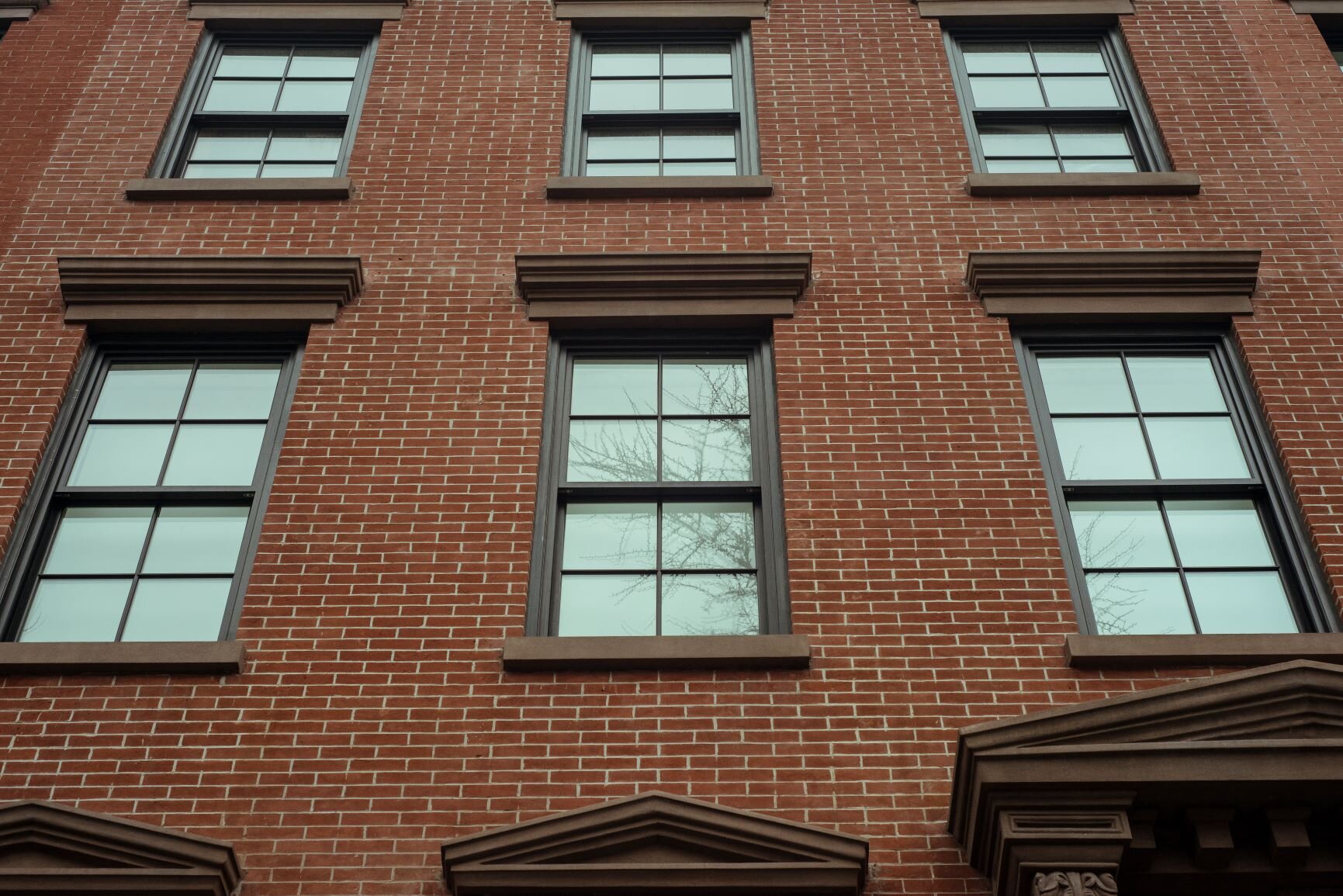
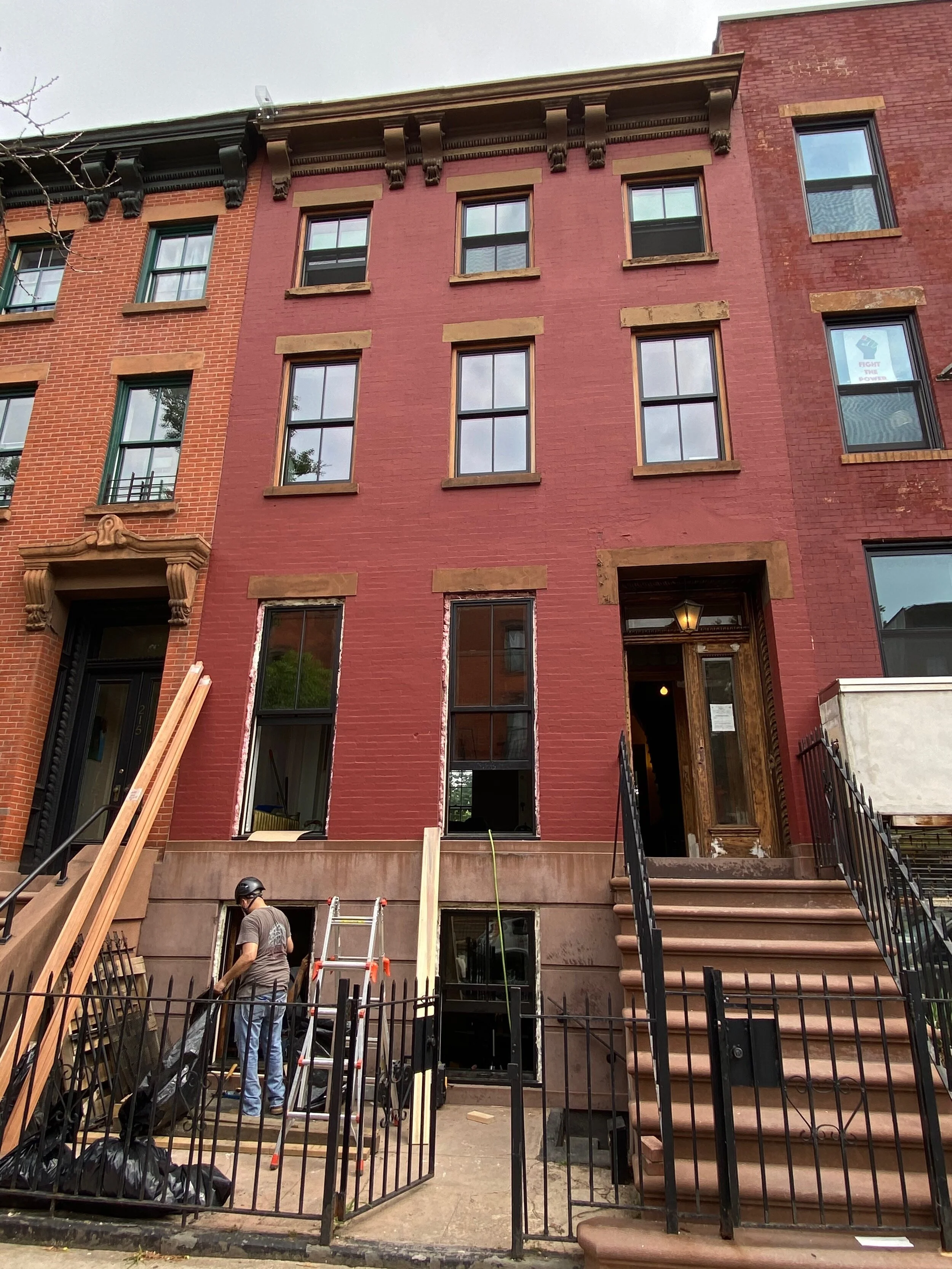
We worked on this handsome red brick Landmark, installing ten custom high performance windows from Jeld-Wen on four levels.

The DeKalb project in progress. You get a peek of our other project to the left.
We love getting called back to the same neighborhood or block to do more work in the community. This time, it was right next door to one of our former Brooklyn projects.
We worked on a handsome red brick Landmark, installing ten custom high performance windows from Jeld-Wen on four levels.
The argon-filled panes have a low-e film. These high performance measures ensure the interiors will stay warmer in winter and cooler in summer. This not only saves money on utilities, but also lowers the building’s carbon footprint.
The two-over-two double hung windows are finished in black, which contrasts beautifully with the brick exterior. The color choice also complements the neighboring building’s custom green trim.
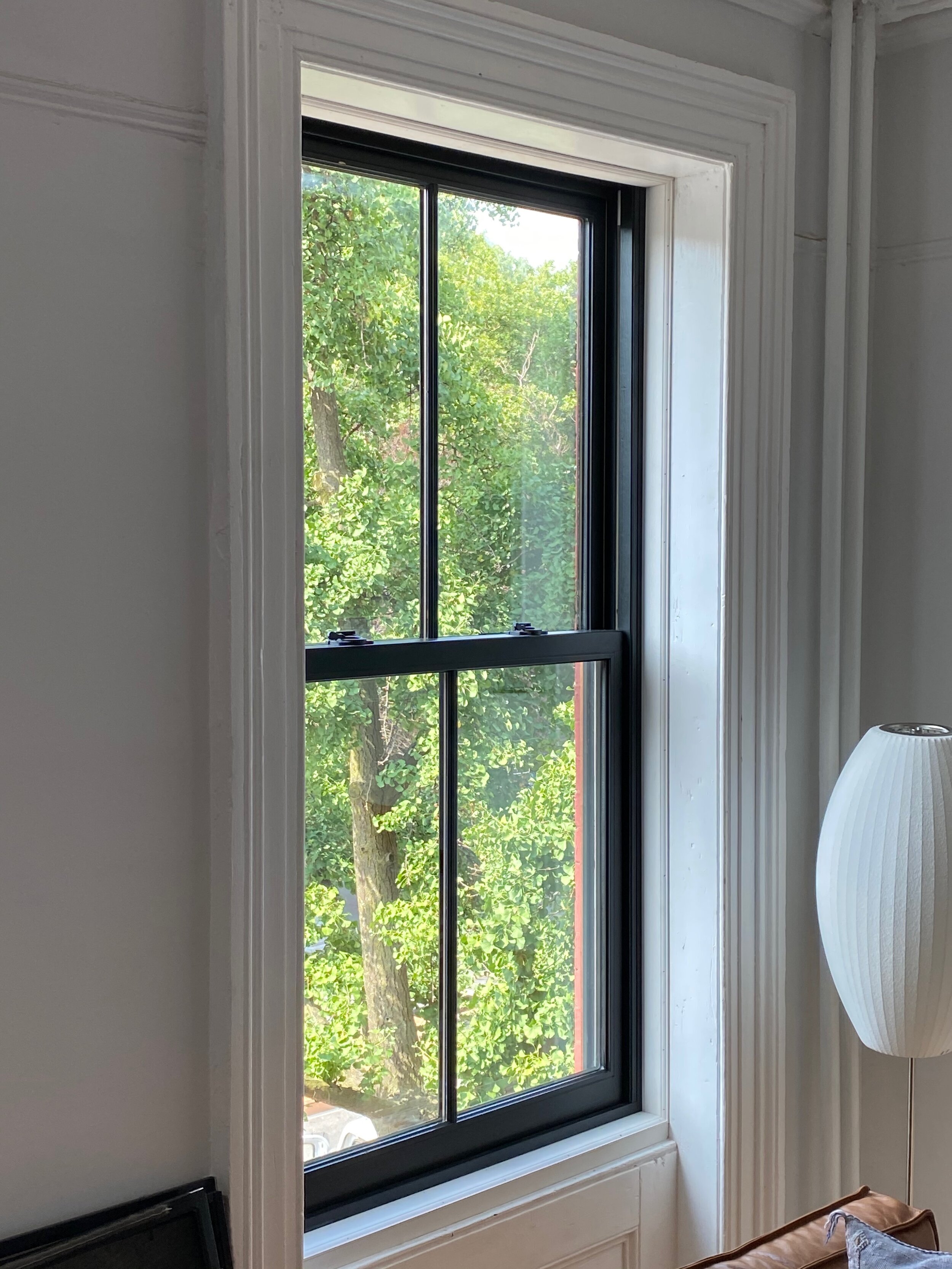
Black with oil rubbed bronze hardware pops against the white interior paint.
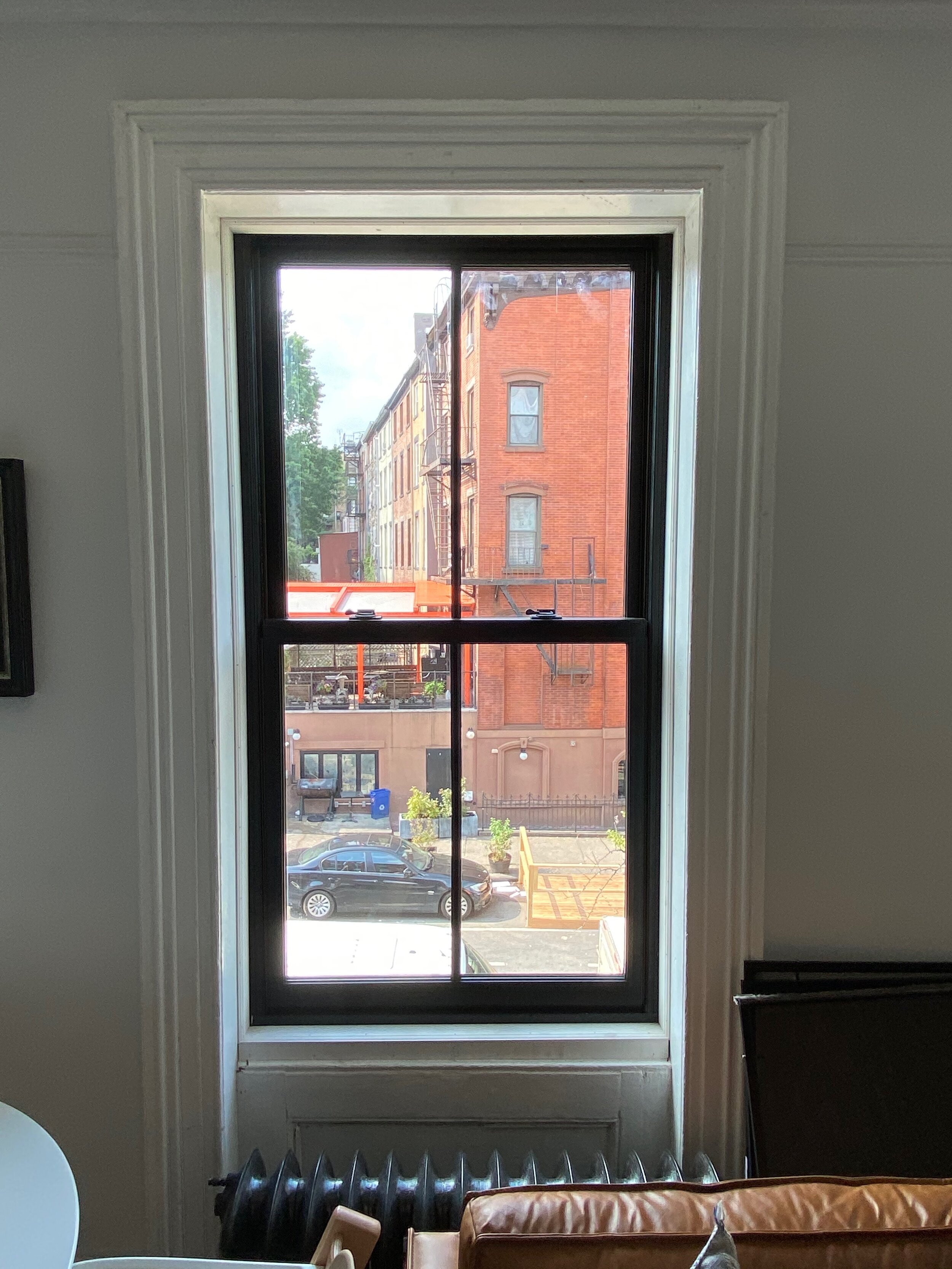
The high performance measures don’t impact the clarity of the glass in the least.

Double-hung windows are perfect for summer
Double-hung windows are one of the most common, and popular, window styles. They consist of two sashes, one hung over the other. The lower sash raises and the upper sash lowers, with the potential for the two sashes to bypass each other.
Double-hung windows are one of the most common, and popular, window styles.
Double-hung windows consist of two sashes, one hung over the other. The lower sash raises and the upper sash lowers, with the potential for the two sashes to bypass each other. A single-hung window has a stationary top sash, where only the lower sash can raise and lower.
Why double-hung?
One of the most attractive characteristics of a double-hung window is that both sashes operate. This gives you control over ventilation. Because hot air rises, when you lower the upper sash the hot air near your ceiling will exhaust out the open window. Any cooking smoke or steam that rises will also exhaust through an open upper sash.

This is especially effective when the outdoor temperature is lower than the inside temperature. When you raise the lower sash, cooler air will flow in from the outside.
Double-hung windows are machines
While windows look fairly simple, when you consider how they operate you get a glimpse of how they are really sophisticated machines that are meant to move. Double-hung windows are usually either operated by a weight and chain system or spiral balance system.
Windows operated by weight and chain, or sometimes called weight and pulley, have a chain (or cotton cord) that connects the sash to a weight that is concealed in the wall next to the window. The weight is balanced against the weight of the sash, so that when you raise the sash you only need enough force to overcome the weatherstripping and the hidden weight does the rest of the work for you.
Weight and chain windows are easy to operate, even when the sashes are heavy. They are also easy to repair. Some historical requirements may call for weight and chain windows. However, they do need enough room in the wall cavity for the weight chambers, and when you have side by side windows you need a wider mullion to compensate for the weight chambers behind. They are also more expensive than spiral balance windows.
Spiral balance windows utilize a spiral rod and spring in a narrow tube concealed by the window’s side jambs. When the sash is lifted, the rod attached to the bottom of the sash rotates and lifts the window. They require significant force to open; for a window sash that weights 100 pounds you need 30 pounds of force to raise the sash.
Spiral balance windows are lighter and easier to install and need little in the way of mull width for windows that are directly adjacent. They are less expensive than weight and chain windows, but may not meet all historical requirements. The spring mechanism has a limited number of “lifts” and are more difficult to repair than weight and chain windows. Very large or heavy windows may need to the counterbalance provided by weight and chain in order to be lifted to open.
There are other ways to operate double-hung windows, such as block and tackle or coil balance, but they are less common.